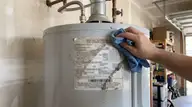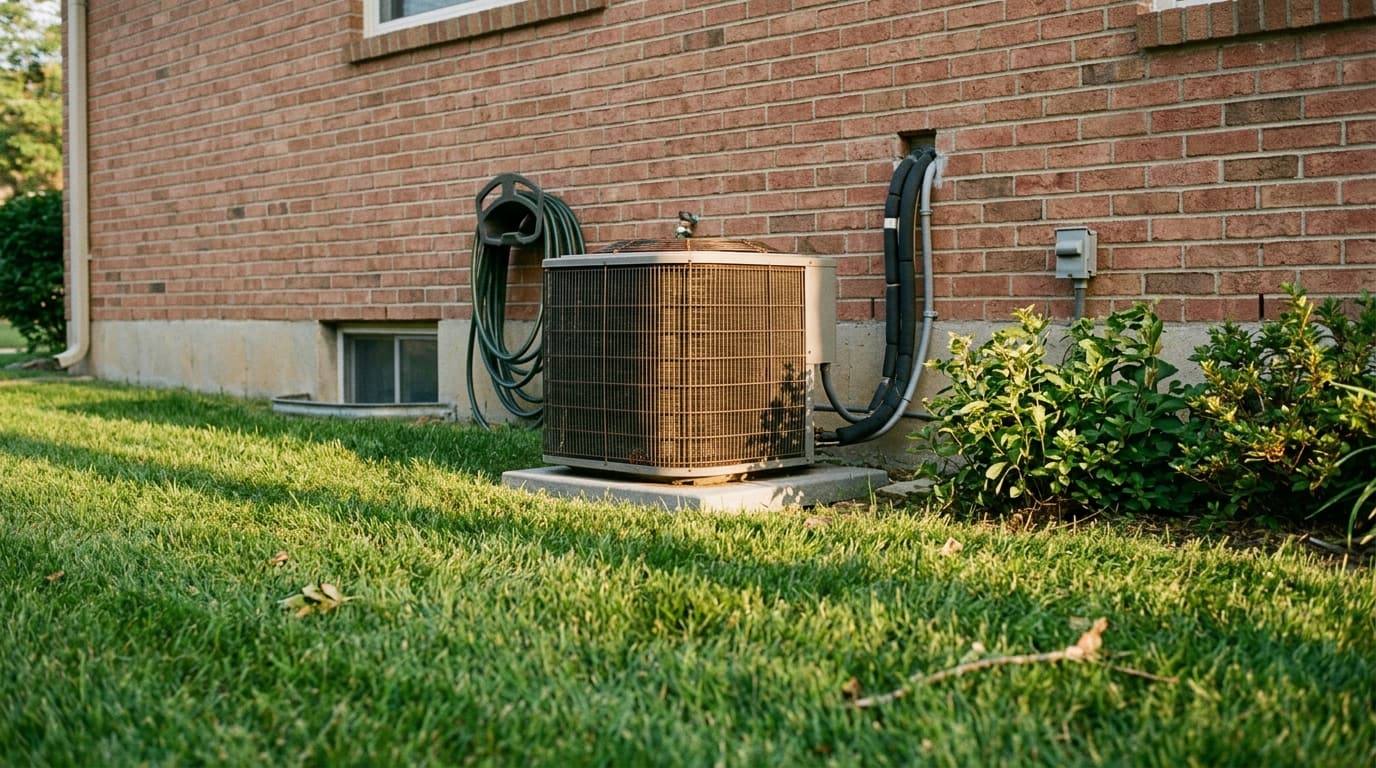
Find the rating plate
Every central air conditioner, heat pump and furnace has a rating plate: a label with the model number, the serial number and the electrical or gas ratings. It’s where any HVAC serial number lookup starts, and the quickest route to answering “how old is my AC unit?” or “how old is my furnace?”
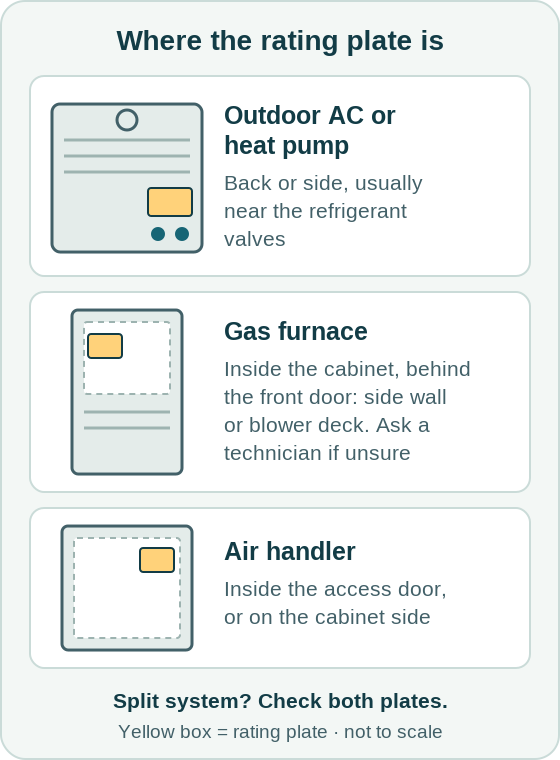
| Equipment | Where the maker says to look |
|---|---|
| Outdoor condenser (central AC) or heat pump | On the back of the unit near the refrigerant service valves (Carrier; Goodman says “slightly above the refrigerant valves”). Lennox says near the service panel |
| Gas furnace | Inside the cabinet, behind the front door panel (Carrier). Lennox: behind the top-front service panel, on the left side of the cabinet or the top of the blower deck, depending on the model |
| Air handler | Inside the front door panel (Carrier) |
| Packaged unit (all-in-one, outdoors) | One plate for the whole unit: on one end (Trane, CPSC 2005), on the back (Trane, CPSC 2025) or on the control compartment door at the front (Goodman, CPSC 2008) |
Basis: official (Carrier, Lennox and Goodman homeowner FAQs; Rheem’s model and serial page; CPSC recall notices 05-104, 08-555 and 25-369).
The outdoor plate is on the outside of the cabinet; don’t open the electrical access panel to look for it. If you’d rather not open a furnace or air handler, the installer’s paperwork may carry the details. Goodman says many dealers attach the shipping box’s “traveler label” to the homeowner’s paperwork. A licensed HVAC technician can read the plate during a service visit.
Photograph the whole plate. The serial number gives the date; the model number identifies the unit for parts, warranty and recall checks.
A split system has two plates
Rheem puts it simply: two model and serial tags identify split-system equipment, and one tag identifies packaged equipment. The outdoor unit (condenser or heat pump) and the indoor unit (furnace or air handler) each have their own plate. They can show different dates, because either part may have been replaced on its own. Check both: if you’re asking how old your heat pump or AC unit is, read the outdoor plate; for the furnace or air handler, read the indoor one. (The different-dates point is our reading, not a Rheem statement.)
A printed date beats any decode
Some plates print the manufacture date outright. CPSC’s 2005 notice on Trane and American Standard packaged units describes plates showing the year, month and day of manufacture. If your plate shows a date, use it and skip the serial code.
HVAC serial number lookup by brand
Reading AC unit age by serial number depends on the brand. The checker above reads the brands marked “decoded now”. For the others we haven’t yet finished the source checks we need before a decoder goes live.
| Brand | Status | What the date code looks like |
|---|---|---|
| Goodman, Amana HVAC, Daikin (US ducted central systems) | Decoded now | First four digits = year and month (YYMM). Goodman’s example: 1306… = June 2013. See Goodman serial number age |
| Carrier, Bryant | Decoded now | First two digits = week, next two = year, then a plant letter. Carrier’s manual example: 01 18 E 00001 = week 1 of 2018. See Carrier serial number age |
| Payne | Not decoded | Payne is now WeatherMaker by Carrier, but we haven’t found a Carrier or Payne document that explains Payne serials |
| Trane, American Standard | Decoded now | Since 2010: first two digits = year, next two = fiscal week, then a day digit. Older serials start with one year digit (2002 to 2009) or a year letter. Example from a CPSC recall: 24061381FA = week 6 of 2024. See Trane and American Standard below |
| Lennox | Coming soon | Details when the decoder is ready |
| York | Not decoded | We haven’t found a manufacturer document that explains the code, and the published secondary charts we checked don’t agree |
| Rheem | Not decoded | Same problem: no manufacturer explanation found for HVAC units, and secondary references disagree on whether the week or the year comes first |
| Ductless mini-splits (all brands) | Not decoded | We haven’t found manufacturer documentation for reading a date from these serials. Use the date printed on the plate or ask the maker |
Basis: official (Goodman and Daikin warranties; CPSC 05-104 and 25-369, which name Trane and American Standard together; Carrier 24VNA6/25VNA4 service manual; Bryant service manual; Payne’s website; Trane product handbook 22-8301-39). The “not decoded” rows are our assessment of the sources we found as of 14 October 2026.
For any brand, the maker’s support line or a licensed HVAC technician can confirm the date from the model and serial number.
Trane and American Standard
Trane’s 2026 product handbook has a page called “Equipment Date Identification.” It says the serial numbers on all Trane central air conditioning and heating products identify “the year and fiscal week of product manufacture.” How you read it depends on when the unit was made, and the American Standard serials we found documented follow the same rule.
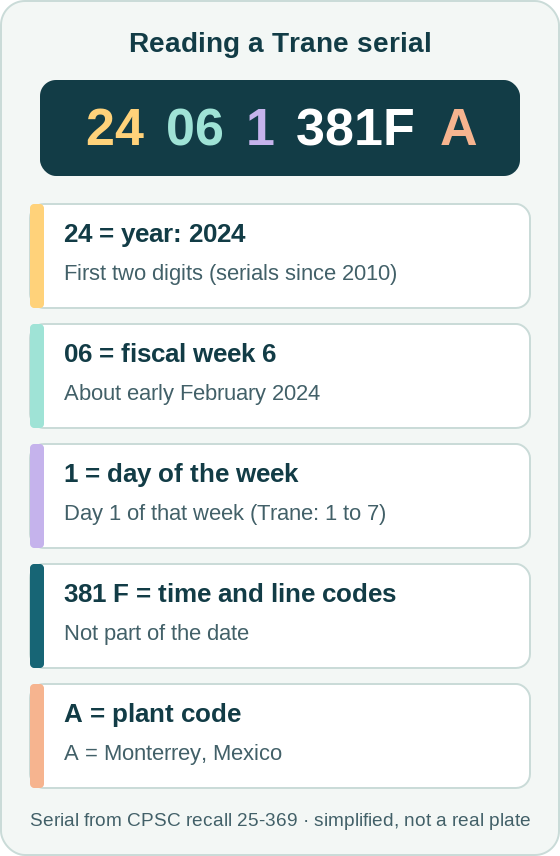
How to read a Trane serial number
| Serial starts with | Means |
|---|---|
| Two digits (2010 on, ten characters) | The year: 10 = 2010, 24 = 2024. Then the fiscal week (two digits) and the day of the week (one digit, 1 to 7) |
| One digit from 2 to 9 (nine characters) | The year: 2 = 2002 through 9 = 2009. Then the fiscal week and the day |
| A letter (nine characters) | The year, 1980 to 2001, from Trane’s letter table below. Then the fiscal week and the day |
Trane’s ten-digit layout began in 2004, but its first position stays blank until 2010, so serials from 2004 to 2009 print nine characters (2009 may print 09). The last five characters are a time stamp, a line code and a plant code (A = Monterrey). That’s the Trane serial number age rule; the checker above applies it and gives your Trane AC age, heat pump age or furnace age in years.
Basis: official (Trane Product Handbook 22-8301-39, effective 1 January 2026).
Year letters, 1980 to 2001
| Letter | Year |
|---|---|
| O or A | 1980 |
| T, U, W, X, Y | 1981 to 1985, in that order |
| S | 1986 |
| B, C, D, E, F, G, H | 1987 to 1993, in that order |
| J, K, L, M, N, P | 1994 to 1999, in that order |
| R, Z | 2000, 2001 |
The letters skip I, Q and V, and S and Z are out of order, so don’t count through the alphabet.
Basis: official (Trane handbook year table).
A fiscal week, not a month
The checker shows the month the fiscal week falls in (week 6 is early February) and says so when a week spans two months. Trane doesn’t publish a week-to-date table; the conversion is ours.
The next digit is the day of the week, 1 to 7, but Trane’s handbook doesn’t say which day is 1. Trane Technologies’ decoder for its Oxbox brand reads the same digit as “1 = Monday.” The checker reports the day as a number.
Trane worked examples
| Serial (source) | Reads as |
|---|---|
| 24061381FA (CPSC 25-369) | 2024, fiscal week 6, about February 2024; day 1; plant A (Monterrey) |
| 24453189FA (CPSC 25-369) | 2024, fiscal week 45, about November 2024; day 3 |
| 3383… (CPSC 05-104) | 2003, fiscal week 38, about September 2003; day 3 |
| 4475… (CPSC 05-104) | 2004, fiscal week 47, about November 2004; day 5 |
| 19273 (Trane furnace date code) | 2019, fiscal week 27, day 3: Trane pairs it with “on or after 7/3/19” |
| M124X04CF (Trane handbook) | 1997, fiscal week 12, about March 1997; day 4 |
The recalled units were sold in the periods CPSC lists, which fit these readings. M124X04CF is Trane’s layout illustration, not a known unit.
Basis: official (CPSC recall notices; Trane handbook).
American Standard serials
The checker reads American Standard serials with Trane’s rule:
- CPSC’s 2005 notice covered Trane and American Standard packaged units and said “The first four digits of all serial numbers indicate the year, fiscal week and day of manufacture.”
- CPSC’s 2025 notice covers five models “sold under Trane and American Standard brand names” with one set of serial ranges.
- The outdoor-unit plate drawn in Trane’s serial-number guide names American Standard Inc. as manufacturer of Trane and American Standard.
These sources document American Standard serials from 2003–04 and 2024, plus the undated plate. Reading an older American Standard year letter with Trane’s table is our inference, so the checker gives it lower confidence. For American Standard AC age or furnace age, choose American Standard in the checker above.
Basis: official (CPSC 05-104 and 25-369; Trane’s serial-number guide).
Where Trane puts the serial number
| Unit | Where Trane’s guide puts the label |
|---|---|
| Outdoor AC or heat pump | Top, right-rear of the outdoor unit |
| Furnace | Right or left side panel |
| Air handler | Front panel |
| Indoor coil (with the furnace) | Front panel |
| Packaged unit (all in one, outdoors) | Rear panel; CPSC’s 2005 notice says “one end of the unit” |
The plates in that guide also carry a date line: “MFR DATE” on the outdoor unit, “Date of manufacture: MM/YY” on the furnace. Don’t open electrical or burner compartments to look.
Basis: official (Trane’s serial-number guide, linked from its warranty lookup; CPSC 05-104).
Trane serial number lookup vs warranty lookup
The serial gives the build date. For coverage, Trane’s official Warranty Lookup asks for “a serial number connected to your registration” and shows the warranty terms. For an American Standard serial number lookup of coverage, use American Standard’s warranty and registration page.
Basis: official (Trane and American Standard warranty pages).
Trane codes that can read two ways
- A short entry starting with 2. Typed alone, 2406 could be 2024, week 6 (ten characters) or 2002, week 40 (nine). The checker shows both; the full serial’s length settles it.
- Furnaces. Trane’s table has a second year column, headed “Ducane Oil / Horizontal Gas Furnaces,” with L = 1980, M = 1981, N = 1982, 9 = 1983 and Q = 1984. Those first-character codes fit dedicated horizontal gas furnaces, whose production “ceased after introduction of convertible furnaces.” For a furnace the checker shows both readings.
- Not decoded: Ducane oil furnaces made before 1996, which carry the date in the last four digits (Trane’s example 123456-8540 = 1985, week 40); the checker won’t date an all-digit furnace serial. Also accessories and coils with a three-digit date code.
The checker doesn’t date units more than 45 years old, so a 1980 reading (O or A) is refused.
Basis: official (Trane handbook).
How long a Trane lasts, and its recalls
Trane says “In general, a central air conditioner will last about 15 years,” depending on quality, installation, climate, use and maintenance. ENERGY STAR’s replacement ages and the other published ranges are in the lifespan table below. CPSC recalls 05-104 and 25-369 covered Trane and American Standard packaged units; the models, serial ranges and remedies are under Recalls below.
Basis: official (Trane; ENERGY STAR; CPSC 05-104 and 25-369).
How long AC units, heat pumps and furnaces last
HVAC age matters most when you compare it with a typical lifespan. Published figures vary; here is what three US sources say:
| Equipment | InterNACHI estimate | NAHB study (2007) | ENERGY STAR: consider replacing when older than |
|---|---|---|---|
| Central air conditioner | 7–15 years (condenser 8–20) | 10–15 years | 10 years |
| Heat pump | 10–15 years | 16 years | 10 years |
| Furnace | 15–25 years | 15–20 years | 15 years |
Basis: trade estimate (InterNACHI’s Standard Estimated Life Expectancy Chart, which InterNACHI says should be used “as guidelines only”); industry study (NAHB/Bank of America Home Equity Study of Life Expectancy of Home Components, February 2007); official (ENERGY STAR’s “When is it time to replace?” page). The NAHB figures are averages from a 2007 study.
The checker above compares your unit’s age with typical lifespans like these.
What the age means for repair or replace
The age is a planning number, not a verdict on one unit.
- Under about 10 years (AC or heat pump) or 15 years (furnace): younger than the ages at which ENERGY STAR suggests considering a replacement.
- Past those ages: ENERGY STAR lists age as one sign to consider replacing. Its other signs include frequent repairs with rising energy bills, rooms that are too hot or too cold, humidity problems, excess dust and a noisy system.
- Near or past the top of the published ranges: older than most of the figures above. It’s sensible to budget for a replacement even if the unit still runs (our suggestion, not a source’s).
Don’t attempt gas, refrigerant or electrical work yourself. For a diagnosis, a repair quote or a replacement estimate, hire a licensed HVAC technician. Buying a house? Record each unit’s age in your inspection notes. Our home systems age report (with tools for home inspectors) puts appliances, water heaters and HVAC units (Goodman family, Carrier, Bryant, Trane and American Standard decoded) on one printable page. For the water heater, see how old is my water heater?
Recalls
CPSC does recall furnaces and packaged heating and cooling units, and its notices often define the recalled units by a serial number range that encodes the build date. Three examples:
- Trane and American Standard, 05-104 (Feb 2005): about 18,200 gas/electric packaged units sold October 2003 to December 2004: models starting YCP or YCX with serial numbers beginning 3383 through 4475, and YCY or YCZ with 4282 through 4475. CPSC explains that the first four digits give the year, fiscal week and day of manufacture. Remedy: a free inspection.
- Goodman, 08-555 (2008): package gas-electric units with serial numbers beginning 0712, 0801 and 0802, sold December 2007 through February 2008.
- Trane and American Standard, 25-369 (Jul 2025): about 4,790 gas/electric packaged units, five models with listed serial ranges, sold January 2024 through March 2025. Remedy: stop using the heating mode; free inspection and ignition board replacement.
Basis: official (CPSC notices in the sources). Search CPSC’s furnace recalls and the full CPSC recall list with your brand and model number, and confirm the exact models and serial ranges on the notice.
Our recall check covers appliances and water heaters only. It doesn’t check HVAC equipment yet.
Limitations
- The serial gives the build date, not the installation date. A unit can sit in a warehouse before it’s installed. Goodman’s warranty, for example, assumes installation three months after the manufacture date when the real date can’t be verified.
- Some brands’ codes (Carrier’s and Trane’s, for example) give a week of the year, not a month.
- The serial can’t tell you the unit’s condition, or maintenance history. Ask a licensed HVAC technician about those.
Checked against the sources below on 14 October 2026. The Trane and American Standard section moved here from its own page on 1 November 2026 (last checked 16 October 2026), with its sources.