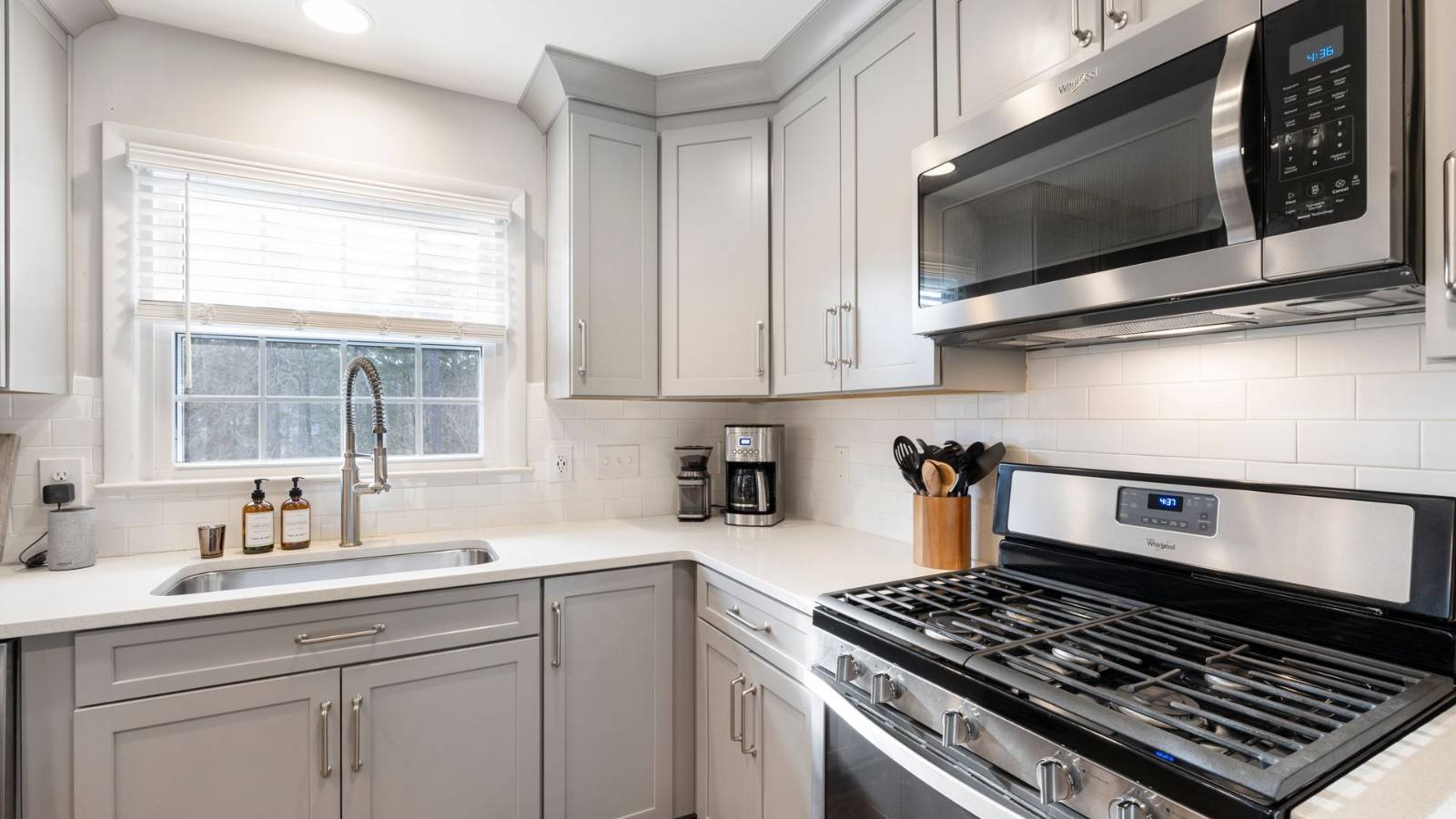
Stove and oven lifespan by source
“Stove”, “range” and “oven” get used interchangeably. Most of the published figures are for a range — the freestanding or slide-in unit with burners on top and an oven underneath. Here is what each source says.
| Source | Lifespan | What it’s based on | Basis |
|---|---|---|---|
| NAHB / Bank of America study (2007) | 15 years gas, 13 years electric | 2006 telephone survey of manufacturers, trade associations and researchers | industry study (NAHB) |
| InterNACHI life expectancy chart | 15 to 17 years gas, 13 to 15 electric | Home inspectors’ chart, assuming regular recommended maintenance and normal wear | industry study (InterNACHI) |
| US Department of Energy, 2024 cooking-products rule | 14.5 years gas, 16.8 years electric | Average lifetime used in the federal efficiency analysis for consumer conventional cooking products | official (US DOE) |
| Fannie Mae useful-life tables (2019) | 15 years (multifamily; 25 for co-op and seniors housing) | Guide for assessing apartment buildings, not single-family homes | industry guideline (Fannie Mae) |
| Range used by the checker above | 13 low / 15 typical / 17 high | Low is the NAHB and InterNACHI electric figure of 13; high is InterNACHI’s gas 17, which DOE’s electric 16.8 rounds to; typical is the median of the six central figures (NAHB 13 and 15, InterNACHI midpoints 14 and 16, DOE 14.5 and 16.8), which is 14.75, rounded to 15 | our estimate |
A range lasts longer than most other major appliances on these same charts. For comparison, the equivalent figures we use are 12 years for a refrigerator, 13 for a dryer, and 10 each for a washer and a dishwasher.
These are typical replacement ages, not a hard limit. The NAHB study is explicit that appliances “are often replaced long before they are worn out because changes in styling, technology and consumer preferences make newer products more desirable.” A range that comes out during a kitchen remodel may have years left in it.
Gas vs. electric: the sources disagree
This is the one place where the published data genuinely contradicts itself, so it’s worth being clear about it.
| Source | Gas | Electric | Which it favours |
|---|---|---|---|
| NAHB (2007) | 15 years | 13 years | Gas, by 2 years |
| InterNACHI | 15 to 17 years | 13 to 15 years | Gas, by 2 years |
| US DOE (2024) | 14.5 years | 16.8 years | Electric, by 2.3 years |
Basis: as cited in the table above.
The two home-industry charts put gas ahead. The federal analysis puts electric ahead. The gap in both directions is only about two years, which is smaller than the difference between a well-maintained unit and a neglected one. Our practical reading: treat gas and electric as broadly similar, and judge the individual unit rather than the fuel type. We use one combined 13–17 range rather than pretending the disagreement is settled.
None of the four sources publishes a separate lifespan for induction ranges, so we don’t either.
What shortens or extends a range’s life
The NAHB study notes that the life expectancy of housing components “is greatly affected by the quality of maintenance.” None of our sources puts a number of years on what maintenance adds to a range specifically, so treat the following as ways to avoid problems rather than as a lifespan guarantee:
- The control boards are the expensive electronics. Trade guides price a stove control board at $200 to $600 and an oven control board at $150 to $300, against $75 to $150 for a knob or switch.
- Spills that reach the burners or the glass top. Glass-top replacement is one of the costliest common repairs, at $250 to $600.
For anything involving gas lines or wiring, hire a licensed technician. We don’t publish gas or electrical repair instructions.
Signs a range may be near the end
No source we reviewed publishes a checklist of symptoms that prove a range is finished. What the data does show is when a repair stops making sense.
What common repairs cost. Three independent trade guides put most stove and oven repairs at $150 to $350 (Angi $108 to $251 for stoves and $130 to $310 for ovens, HomeGuide $150 to $350, Fixr $150 to $400). Individual jobs, as of September 2026:
| Repair | Typical cost | Basis |
|---|---|---|
| Stove glass top replacement | $250 to $600 | trade estimate |
| Stove control board | $200 to $600 | trade estimate |
| Oven control board | $150 to $300 | trade estimate |
| Oven bake element | $150 to $400 | trade estimate |
| Stove igniter | $150 to $300 | trade estimate |
| Oven igniter | $150 to $250 | trade estimate |
| Stove burner replacement | $120 to $250 | trade estimate |
| Oven temperature sensor | $100 to $250 | trade estimate |
| Knob or switch replacement | $75 to $150 | trade estimate |
Basis: trade estimates from Angi, HomeGuide and Fixr, as of September 2026. The $150 to $350 typical band above is the median of the three guides’ low ends and of their high ends; the per-job rows are the ranges quoted for each repair, not medians.
What a new one costs. Our price tiers, built from HomeGuide’s 2026 cost figures, put a basic 30-inch freestanding range at $550 to $900, a convection or entry slide-in at $900 to $1,600, and induction, dual-fuel or double-oven models at $1,600 to $4,000 (our estimate). HomeGuide’s own figures include $530 to $600 for a basic range and $1,000 to $4,000 for induction.
How to decide. Consumer Reports’ rule of thumb is not to spend more than 50% of the cost of a new product on repairing an old one. Put your actual quote into the repair or replace calculator, which applies that rule and sets the range’s age against its typical life. On a $700 basic range, that threshold is $350 — which is the top of the typical repair band, so a single ordinary repair on a cheap range is often a close call, while the same repair on a $2,000 slide-in clearly isn’t.
What this means when buying a used stove
Age is the most useful number you can get out of a listing. Here’s how to use it.
- Find the manufacture date. The serial number on the rating plate encodes it. On most ranges the plate is on the oven door frame, on the frame behind the storage drawer, or under the cooktop. The brand guides show where and how: Whirlpool, Maytag, GE, Frigidaire, LG, KitchenAid, Amana, Bosch and Kenmore.
- Compare the age with the typical life. An 8-year-old range measured against a typical 15-year life has about 7 years left on average; against the 13 and 17 ends, anywhere from 5 to 9. That is subtraction, not a prediction. Averages hide wide variation and the condition of the individual unit matters more.
- Price in a likely repair. Add $150 to $350 for an ordinary repair, more if the glass top or control board is involved, and check the numbers against the price you’re being asked.
- Check for recalls. Ranges and their anti-tip brackets appear in recall notices. Use our recall check with the model number, then confirm on the official list at CPSC.gov.
- Confirm the fuel and the power supply before you buy. A gas range and an electric range are not interchangeable, and electric ranges need a dedicated high-voltage outlet. Installation is a job for a licensed technician.
The energy angle
A range is not a refrigerator: it draws power only while you’re cooking, so the running-cost argument for replacing an old one is much weaker than it is for a fridge.
ENERGY STAR’s residential criteria for electric cooking products cover cooktops and ranges, but not standalone ovens, and gas cooking products are not eligible for ENERGY STAR certification. So for most used ranges on the market there is no ENERGY STAR comparison to make at all. Judge a used range on its condition and its repair history, not on an efficiency label.
Limitations
- Every figure here is an average or a rule of thumb. None of them can tell you how one particular used range was treated.
- The NAHB figures come from a 2006 survey. The InterNACHI chart assumes regular maintenance. The DOE figure is an input to a federal efficiency analysis, not a warranty.
- The gas-versus-electric picture is genuinely unsettled, as the table above shows.
- None of these sources separates brands, and we don’t rank brands.
- Induction, dual-fuel and commercial-style ranges are not broken out in any of the four sources.
What to do next
- Find the unit’s age: enter the brand and serial in the checker above
- Not sure which number is the serial? Appliance model number lookup
- See what it’s worth: how much is my used appliance worth
- Got a repair quote? Run it through the repair or replace calculator
- Inspect before you pay: used appliance buying checklist
- Check for recalls: appliance recall check
Checked against the sources below on 26 September 2026.